Keycard Hardware Wallets
Keycard builds open-source signing hardware: smart cards with a Common Criteria EAL6+ secure element, and the Keycard Shell, an air-gapped QR signer that keeps every private key on a removable card. Its devices support Bitcoin and Ethereum/EVM networks only.
Keycard Wallet Models
Explore the complete range of Keycard hardware wallets designed for different needs and budgets.
Affiliate link — we may earn a commission at no extra cost to you. Learn more
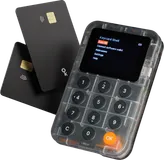
Keycard Shell
Air-gapped QR signer that keeps keys on removable EAL6+ smart cards. Bitcoin and EVM only, open-source firmware, $129 with two Keycards.
Pros & Cons of Keycard Wallets
Pros
- Shell firmware is MIT-licensed with reproducible builds; hardware files are published under CERN-OHL-S v2
- Private keys stay on a removable smart card with a CC EAL6+ NXP JCOP4 P71 secure element
- The Keycard Shell has no Wi-Fi, Bluetooth or cellular radio and signs through QR codes
- The same seed can be loaded onto spare cards, and SLIP-39 Shamir shares are supported
Cons
- Only Bitcoin and Ethereum/EVM networks; Solana and other non-secp256k1 chains are not supported
- No published third-party security audit of the Shell firmware or the Keycard applet
- The Keycard Shell interface is available in English only
- Narrow range: a single signing device, the Keycard Shell
Keycard Rating Summary
How We Rate Keycard Wallets
Every rating is based on 40 measurable parameters with a fully transparent, open formula. No pay-to-play, no hidden criteria.
Ready to Choose Your Keycard Wallet?
Based on our analysis, the Keycard Shell is the top-rated model with a score of 66/100.
Who Is Keycard Best For?
Keycard wallets are designed for specific types of users and use cases.
Air-gapped cold storage
The Shell has no wireless radios and exchanges transactions with companion wallets such as Sparrow or MetaMask through QR codes. Keys never leave the smart card.
Learn more →Ethereum and DeFi signing
Clear signing decodes ERC-20 transfers and approvals, EIP-712 messages, Permit/Permit2 and Safe transactions on the Shell's screen before approval.
Learn more →Bitcoin multisig
The Shell signs PSBTs, including BIP-48 multisig setups, and exports xpubs by QR code to coordinators such as Sparrow or Nunchuk.
Learn more →Keycard vs Other Wallets
See how Keycard compares to other leading hardware wallet brands.


Keycard vs Keystone
Both sign through QR codes, but the Keystone 3 Pro ($149) keeps keys inside the device, which uses three secure chips, while the Keycard Shell stores them on a removable EAL6+ smart card.

Keycard vs Tangem
Both keep keys on secure-element cards, but a Tangem card is tapped to a phone over NFC, while a Keycard sits in the Shell's contact slot and signs offline via QR.

Keycard vs Foundation
The Foundation Passport Prime ($349) is Bitcoin-only and lists Bluetooth and NFC, whereas the Keycard Shell has no wireless radios and covers Bitcoin plus Ethereum/EVM networks.

About Keycard
Keycard began inside Status as the Status Hardwallet, presented at Devcon3 in 2017, and was relaunched under the Keycard name in 2019. Status describes Keycard as a subsidiary, the Keycard website states that it is part of the Institute of Free Technology, and its press releases are datelined Zug, Switzerland.
The product line has two parts. Keycard smart cards run an open JavaCard applet on an NXP JCOP4 P71 secure element certified to Common Criteria EAL6+. The Keycard Shell, listed at $129, is a stateless signer with a screen, keypad and camera that exchanges data through QR codes and holds no keys itself: the private keys stay on the inserted card.
The Shell firmware is MIT-licensed with reproducible builds, and the hardware design files are published. No third-party security audit of the Shell firmware or the card applet has been published.
Open Source
The Shell firmware (MIT, reproducible builds), the Keycard applet and the hardware design files are all public on GitHub.
Security
Keys are generated and stored on a CC EAL6+ NXP JCOP4 P71 card; the Shell's microcontroller never handles key material.
Backup & Recovery
One seed can be loaded onto several Keycards, and BIP39 phrases, SeedQR and SLIP-39 Shamir shares can be imported.
FAQ About Keycard Hardware Wallets
Is Keycard part of Status?
Yes. Keycard started at Status as the Status Hardwallet in 2017 and was renamed Keycard in 2019. Status calls Keycard a subsidiary, and the Keycard website describes it as part of the Institute of Free Technology. A Keycard also works directly with the Status app, over NFC on mobile or through a USB card reader on desktop.
Is Keycard open source?
According to Keycard, yes, across the stack. The Keycard Shell firmware is MIT-licensed and builds reproducibly, the JavaCard applet that runs on the cards is public, and the Shell hardware files are published under CERN-OHL-S v2. Open code allows independent review, but no third-party audit report of the firmware or the applet has been published.
Which cryptocurrencies does Keycard support?
Keycard devices support Bitcoin and Ethereum, including EVM-compatible networks and layer 2s. Bitcoin support covers legacy, SegWit and multisig address types; Taproot was added in Shell firmware 1.4.0 for cards running the v4 applet. Solana and other chains that do not use the secp256k1 curve are not supported.
Can a Keycard be used without the Keycard Shell?
Yes. A Keycard works on its own via NFC with the Status mobile app, or with a USB smart-card reader and Status desktop or Sparrow. The reverse does not apply: the Shell stores no keys and cannot sign without a Keycard inserted. Two unbranded Keycards are included in the Shell box.


Explore Keycard wallets
Read our Keycard Shell review for its security model, supported networks and price.
View best price — from $129Affiliate link — we may earn a commission at no extra cost to you. Learn more