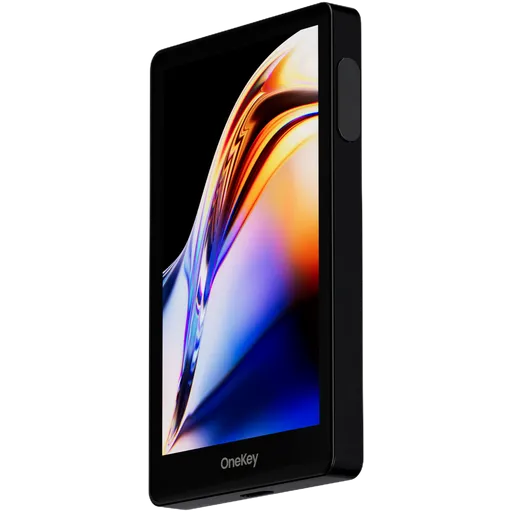
OneKey Neo ($179, launched November 2026): two EAL6+ secure elements, the Pro 2's 3.54-inch AMOLED touchscreen, Bluetooth, NFC and USB-C, but no camera or QR air-gap.
By the WalletInsights editorial team
We may earn a commission from purchases through affiliate links. This does not affect our ratings. Affiliate Disclosure
The OneKey Neo is a $179 multi-chain touchscreen wallet launched on 9 November 2026. It shares the Pro 2's AMOLED screen, battery and safeOS 2 firmware, but uses two THD89 secure elements (CC EAL6+) instead of four and drops the camera, QR air-gap mode, fingerprint unlock and the bundled SeedCard. Keylabs audited it alongside the Pro 2 and found no critical or high issues; the firmware source is not yet public.
Security notice ·
October 2026: free replacement for OneKey devices bought from CryptoBilis
After Ledger found hardware implants in Ledger devices sold by the reseller CryptoBilis, OneKey ended CryptoBilis’s authorization, paused new resellers and began reviewing existing ones. OneKey says no OneKey user has reported losing funds and does not report finding a tampered OneKey device.
As a precaution, OneKey replaces for free any OneKey model bought from CryptoBilis between 1 March and 12 October 2026, activated or not, with proof of purchase. Apply through OneKey support by 31 December 2026; the old device does not need to be returned.
OneKey’s advice: do not activate an unused CryptoBilis unit. If a device from CryptoBilis already holds funds, move them now to a wallet with a newly generated recovery phrase rather than waiting for the replacement.
This concerns one reseller, not the device design, so it does not change our ratings.
The Neo stores keys in two THD89 secure elements from Tongxin Microelectronics, certified to CC EAL6+; OneKey says one protects the private keys and the other the PIN. Keylabs describes the Neo as a second model of the Pro 2 platform, "built from the same firmware source tree using a separate hardware configuration" that configures two secure-element slots instead of four and leaves out the fingerprint and camera drivers.
Firmware signatures are checked by a hardware secure boot chain, and PIN retry limits are enforced inside the secure element. OneKey states that the device erases itself in response to abnormal activity; the exact PIN attempt limit for the Neo is not documented yet. Transactions are reviewed on the screen with Clear Signing.
Keylabs published its final audit of the Pro 2 and Neo on 6 October 2026, retested on firmware 1.0.0. The Neo runs the same secure-element firmware, so the findings apply to both models except one fingerprint issue that concerns only the Pro 2:
no critical or high findings; three medium findings fixed in 1.0.0
two low findings open: a crash record written by the fault handler, and a romloader filesystem interface reachable over USB before PIN entry
rollback protection is enforced on the main processor but not yet in the secure elements, and there is no active tamper-detection circuit
OneKey also names SlowMist as an auditor, but no SlowMist report for the Neo is public. There is no anti-klepto protocol. Keylabs lists the MCU-to-secure-element link as encrypted but USB transport as relying on the host.
SecurityKey Factor
The Neo creates a standard BIP39recovery phrase of 12 or 24 words and can restore an existing one, so a backup made on it remains usable in other BIP39-compatible wallets. It also supports SLIP-39 split backups made of 20-word shares, and an optional passphrase that opens a separate hidden wallet.
Unlike the Pro 2, the Neo ships as the device only. The OneKey SeedCard ($39), an NFC card that stores the recovery phrase in encrypted form, is sold separately, as is the titanium KeyTag. The Neo page lists SeedCard support, but OneKey's help article on the card still names only the Pro and Pro 2, so the compatibility is stated by OneKey rather than documented in detail.
Points to weigh before relying on the SeedCard:
It is a OneKey-specific format; a written BIP39 or SLIP-39 backup remains the vendor-independent fallback.
Restoring from the card requires its PIN, which needs its own secure record.
OneKey has not published technical details of the card's encryption.
There is no vendor or cloud backup of the seed.
Recovery & backups
The Neo uses the same 3.54-inch AMOLED touchscreen as the Pro 2: 1024×604 pixels, up to 800 nits, Gorilla Glass 5 with an anti-reflective coating. It runs safeOS 2 and adds an on-device portfolio view that shows balances across chains; OneKey notes that the full experience requires the OneKey App. Unlocking is by PIN only, since the Neo has no fingerprint sensor.
The spec table lists 84.9 × 53.2 × 6.1 mm and 48 g (the press release states 6.2 mm and 51 g), an anodized aluminum frame and a fiberglass back. The 700 mAh battery charges over USB-C or wirelessly, and OneKey states an IP56 dust and splash rating. The Neo comes in four colors.
The OneKey App runs on iOS 14+, Android 8+, Windows 10+, macOS 10.11+ and common Linux distributions and connects to the Neo by USB-C or Bluetooth. Compared with the Classic 1S ($99), the Neo trades a small monochrome screen and buttons for a large touchscreen, wireless connectivity and a battery that needs charging.
Usability / UX
OneKey states that the OneKey App supports 100+ blockchains and 30,000+ coins and tokens. OneKey's developer documentation lists the same chain set for the Neo and the Pro 2; Stellar, Alephium, the NEO blockchain and Lightning are not supported on either. The app covers sending, receiving, staking and in-app swaps.
For more advanced setups, OneKey names the Neo as a hardware signer for:
Sparrow for Bitcoin
Safe for Ethereummultisig
Squads for Solana multisig
Sparrow's own device list currently names only the OneKey Classic 1S and Pro, so the Sparrow connection rests on OneKey's statement. Rabby connects over USB in the browser extension and over Bluetooth on mobile. MetaMask connects to OneKey devices only by QR code, which the Neo cannot do without a camera.
The Neo also works as a FIDO2 passkey authenticator. Offline TOTP codes and NFC tap-to-authenticate are announced for a future update.
Ecosystem & integrations
The Neo has no air-gap mode: without a camera it cannot sign through QR codes, so every transaction passes over USB-C or Bluetooth to the OneKey App. This is the main functional difference from the Pro 2, whose QR mode disables USB, Bluetooth and NFC data. Users for whom an offline signing path matters should weigh this before choosing between the two.
No account registration is needed, but the OneKey App sends usage analytics, with no documented setting to turn them off. Two privacy features are listed for the Neo but not available yet:
Tor routing for the app, marked as coming soon
Coin Control for choosing which Bitcoin UTXOs a transaction spends, marked as coming soon
The OneKey App's Privacy Mode hides balances on screen, which protects against onlookers but not against network-level observation. Bitcoin users who care about UTXO management may prefer to sign through Sparrow once its support for the Neo is confirmed.
Privacy
The OneKey Neo costs $179 for the device alone, in Cloud White, Mist Black, Moss Green or Blossom Pink. Accessories are extra: the SeedCard and silicone cases cost $39 each and the KeyTag $59. OneKey says the Neo is available now from its own shop and authorized resellers.
The closest comparison is the OneKey Pro 2 at $299. For $120 less, the Neo keeps the screen, battery, IP56 rating, firmware and audit coverage, and gives up:
the camera and QR air-gap signing
fingerprint unlock and Apple Find My
two of the four secure elements (one of which held fingerprint templates)
the bundled SeedCard, case and six months of OneKey App Prime
For buyers who already sign over Bluetooth or USB and do not need an offline path, the Neo delivers most of the Pro 2 for a much lower price. Buyers who want QR signing should look at the Pro 2 or at a QR-only device such as the Keystone 3 Pro.
Price & value
The OneKey Neo is the Pro 2's hardware platform without its most specialized parts. It keeps the 3.54-inch AMOLED touchscreen, 700 mAh battery, IP56 rating and safeOS 2, uses two CC EAL6+ THD89 secure elements, and was covered by the same Keylabs audit, which found no critical or high issues. It drops the camera, QR air-gap signing, fingerprint unlock and the bundled accessories. As with the Pro 2, the main open question is verifiability: the firmware source is not public as of launch day, and several announced features, including Tor, Coin Control and TOTP, are not available yet.
Buy this wallet if:
You want a large touchscreen with Clear Signing for multi-chain and DeFi use, and you sign over USB-C or Bluetooth anyway.
You want SLIP-39 and passphrase options at a lower price than the Pro 2.
You use Safe or Squads multisig and need a signer with a readable screen.
You need publicly verifiable firmware today: the OneKey Pro has public MCU firmware source and Bitcoin-only builds.
You hold only Bitcoin and want a device built for it, such as the Trezor Safe 7 with its Bitcoin-only firmware option.
✓Our Verdict
The OneKey Neo is the Pro 2's hardware platform without its most specialized parts. It keeps the 3.54-inch AMOLED touchscreen, 700 mAh battery, IP56 rating and safeOS 2, uses two CC EAL6+ THD89 secure elements, and was covered by the same Keylabs audit, which found no critical or high issues. It drops the camera, QR air-gap signing, fingerprint unlock and the bundled accessories. As with the Pro 2, the main open question is verifiability: the firmware source is not public as of launch day, and several announced features, including Tor, Coin Control and TOTP, are not available yet.
Buy this wallet if:
You want a large touchscreen with Clear Signing for multi-chain and DeFi use, and you sign over USB-C or Bluetooth anyway.
You want SLIP-39 and passphrase options at a lower price than the Pro 2.
You use Safe or Squads multisig and need a signer with a readable screen.
Skip this wallet if:
You want an offline signing path: the OneKey Pro 2 and the Keystone 3 Pro sign through QR codes.
You need publicly verifiable firmware today: the OneKey Pro has public MCU firmware source and Bitcoin-only builds.
You hold only Bitcoin and want a device built for it, such as the Trezor Safe 7 with its Bitcoin-only firmware option.
Ready to buy OneKey Neo?
We may earn a commission if you purchase through our links. This doesn't affect our editorial independence.
Impermanent loss happens when asset prices in a liquidity pool diverge from external markets, reducing the value of liquidity providers' holdings compared to simply holding the assets.
HardwareSecure Element
A secure element is a tamper-resistant chip built to store secrets and resist physical attacks such as side-channel analysis and fault injection.
EAL Certification (Evaluation Assurance Level) from Common Criteria rates the security of hardware components, like secure chips in crypto hardware wallets. Higher levels, such as EAL5+ or EAL6+, indicate stronger resistance to attacks.
A private key is the secret number that proves ownership of a crypto address and signs its transactions. Whoever has it controls the funds.
SecurityPIN Protection
PIN Protection is a security feature that requires a personal identification number (PIN) to access a cryptocurrency wallet or device, preventing unauthorized access.
Secure Boot is a security feature that ensures only trusted software runs on a device by verifying its integrity during startup, preventing unauthorized code execution in crypto systems.
Clear Signing is a process in blockchain where transaction data is displayed in human-readable form before being signed, ensuring transparency and preventing blind signing risks.
Downgrade protection prevents blockchain nodes from accepting blocks from older protocol versions, blocking rollbacks to vulnerable states via version checks.
The anti-klepto protocol is a signing procedure in which the wallet app adds its own randomness to every signature, so a hardware wallet with malicious firmware cannot leak its key through the signature nonce.
BIP39 is a standard for generating mnemonic seed phrases that are used to create deterministic wallets and securely back up cryptocurrency private keys.
A backup in cryptocurrency is a secure copy of a wallet's seed phrase or private keys. It enables recovery of funds if the original wallet is lost or damaged.
Shamir Secret Sharing (SSS) divides a secret, like a crypto wallet seed, into multiple shares. A threshold number of shares reconstructs it, enhancing security as in SLIP-39 backups.
A passphrase is an additional security layer for cryptocurrency wallets, acting as a 25th word in the BIP39 seed phrase, protecting access to hidden wallets.
A hidden wallet conceals a secondary cryptocurrency wallet behind an additional passphrase on the same seed, providing plausible deniability against coercion.
NFC Connectivity in cryptocurrency enables contactless transactions using near-field communication, allowing users to sign or authorize actions by tapping their device to a reader.
Recovery is the process of restoring access to a cryptocurrency wallet using its seed phrase or mnemonic backup if the original wallet is lost or inaccessible.
Vendor Backup is a service by hardware wallet manufacturers that securely stores encrypted seed phrase shards with third parties, enabling recovery without self-custody of the full seed.
A touchscreen display is a screen that allows users to interact with a device by touching the surface, commonly used in hardware wallets for easy navigation and transaction confirmation.
Bluetooth Connectivity enables wireless communication between devices, like hardware wallets and smartphones, using Bluetooth or Bluetooth Low Energy (BLE) for secure data transfer.
In cryptocurrency, a swap is the direct exchange of one token for another on a blockchain, often via decentralized exchanges (DEXs) without intermediaries.
WalletExternal Signer
An external signer is a hardware wallet or remote device that signs cryptocurrency transactions securely, keeping private keys isolated from the connected software wallet.
Bitcoin (BTC) is the first decentralized cryptocurrency, launched in 2009. It uses blockchain technology for secure, peer-to-peer digital transactions without intermediaries.
Ethereum is a decentralized blockchain platform that enables smart contracts and decentralized applications (dApps). Its native cryptocurrency is Ether (ETH).
Multisig (multi-signature) is a security feature that requires multiple private keys to authorize a transaction, enhancing protection against unauthorized access in blockchain networks.
Solana is a high-performance layer-1 blockchain platform that enables fast, low-cost transactions using Proof of History and Proof of Stake. Its native token is SOL.
QR Code Signing is a method used in cryptocurrency transactions where a QR code is generated to confirm and sign a transaction, enhancing security and user convenience.
Passkeys are a form of passwordless authentication using cryptographic keys for secure, phishing-resistant logins in blockchain and crypto applications.
Offline Signing refers to signing cryptocurrency transactions on a device that is not connected to the internet, ensuring private keys remain secure from online threats.
Telemetry in cryptocurrency and blockchain refers to the automatic collection and transmission of anonymous usage data, metrics, and error reports from wallets or nodes to improve software.
Coin Control is a feature that allows users to manually select which unspent transaction outputs (UTXOs) to use in a transaction, giving more control over privacy and fees.
UTXO (Unspent Transaction Output) is a unit of cryptocurrency from a previous transaction that remains unspent and serves as input for new transactions in blockchains like Bitcoin.
DeFi (Decentralized Finance) refers to a set of financial services, such as lending and trading, built on blockchain technology without traditional intermediaries like banks.
WalletBitcoin-Only Wallet
A Bitcoin-only wallet is a cryptocurrency wallet that supports only Bitcoin (BTC), excluding other cryptocurrencies like Ethereum or altcoins.
OneKey Neo uses a certified Secure Element chip to store private keys in tamper-resistant hardware. Even if the device's software were compromised, the Secure Element isolates your keys from extraction. The firmware is open-source, meaning security researchers worldwide can audit the code for vulnerabilities. The device has been independently security audited.
What if OneKey goes out of business?
OneKey's firmware is open-source — even if the company disappears, the community can maintain the software. Your seed phrase works with any BIP39-compatible wallet, so your funds are always recoverable.
What if I lose my OneKey Neo?
Your cryptocurrency is stored on the blockchain, not on the device. If you lose your OneKey Neo, you can recover full access using your seed phrase on any compatible wallet. OneKey Neo also supports Shamir Secret Sharing, letting you split your backup across multiple secure locations.
How long will OneKey Neo receive security updates?
OneKey actively maintains OneKey Neo with regular firmware updates.
Is the OneKey Neo safe to use?
Keys are generated and stored in two THD89 secure elements certified to CC EAL6+, protected by secure boot and a PIN, with Clear Signing on the device screen. Keylabs' audit of 6 October 2026 covers the Neo together with the Pro 2 and found no critical or high issues; three medium findings were fixed in firmware 1.0.0 and two low ones remain open. The firmware source is not yet public, so builds cannot be checked independently.
What is the difference between the OneKey Neo and the OneKey Pro 2?
Both have the same 3.54-inch AMOLED touchscreen, 700 mAh battery, IP56 rating and safeOS 2 firmware. The Neo ($179) uses two secure elements instead of four and has no camera, so no QR air-gap signing, no fingerprint unlock and no Apple Find My. The Pro 2 ($299) also includes a SeedCard, a case and six months of OneKey App Prime, while the Neo ships as the device only.
Can the OneKey Neo sign transactions offline?
No. The Neo has no camera, so it cannot sign through QR codes. It connects to the OneKey App over USB-C or Bluetooth, and transactions are reviewed and approved on its screen. OneKey's QR air-gap mode is available on the Pro and Pro 2.
How does backup and recovery work on the OneKey Neo?
The device generates a 12- or 24-word BIP39 recovery phrase, supports 20-word SLIP-39 shares for split backups and offers an optional passphrase for hidden wallets. The OneKey SeedCard, an NFC card that stores the phrase in encrypted form, works with the Neo but is sold separately for $39. A written BIP39 phrase remains the most portable backup.
Is the OneKey Neo firmware open source?
OneKey states that safeOS 2 is open source. As of 9 November 2026, however, no public Neo or Pro 2 firmware repository could be found; the existing firmware-pro repository covers the original OneKey Pro. The OneKey App and the hardware SDK are public. Until the safeOS 2 source is published, the firmware claim cannot be checked independently.
Which coins does the OneKey Neo support?
OneKey lists 100+ blockchains and 30,000+ coins and tokens through the OneKey App, including Bitcoin, Ethereum and Solana. OneKey's developer documentation gives the Neo the same chain set as the Pro 2; Stellar, Alephium, the NEO blockchain and Lightning are not supported on either model.
Some links on this page are affiliate links. If you purchase through them, I may earn a commission at no additional cost to you. This helps support the site and allows me to continue creating detailed, independent reviews.
Our rating methodology is evolving. Ratings and assessments will be refined as we improve our scoring framework to reflect the most accurate results.
Ready to Secure Your Crypto?
Find the right hardware wallet based on your needs, budget, and security priorities.